


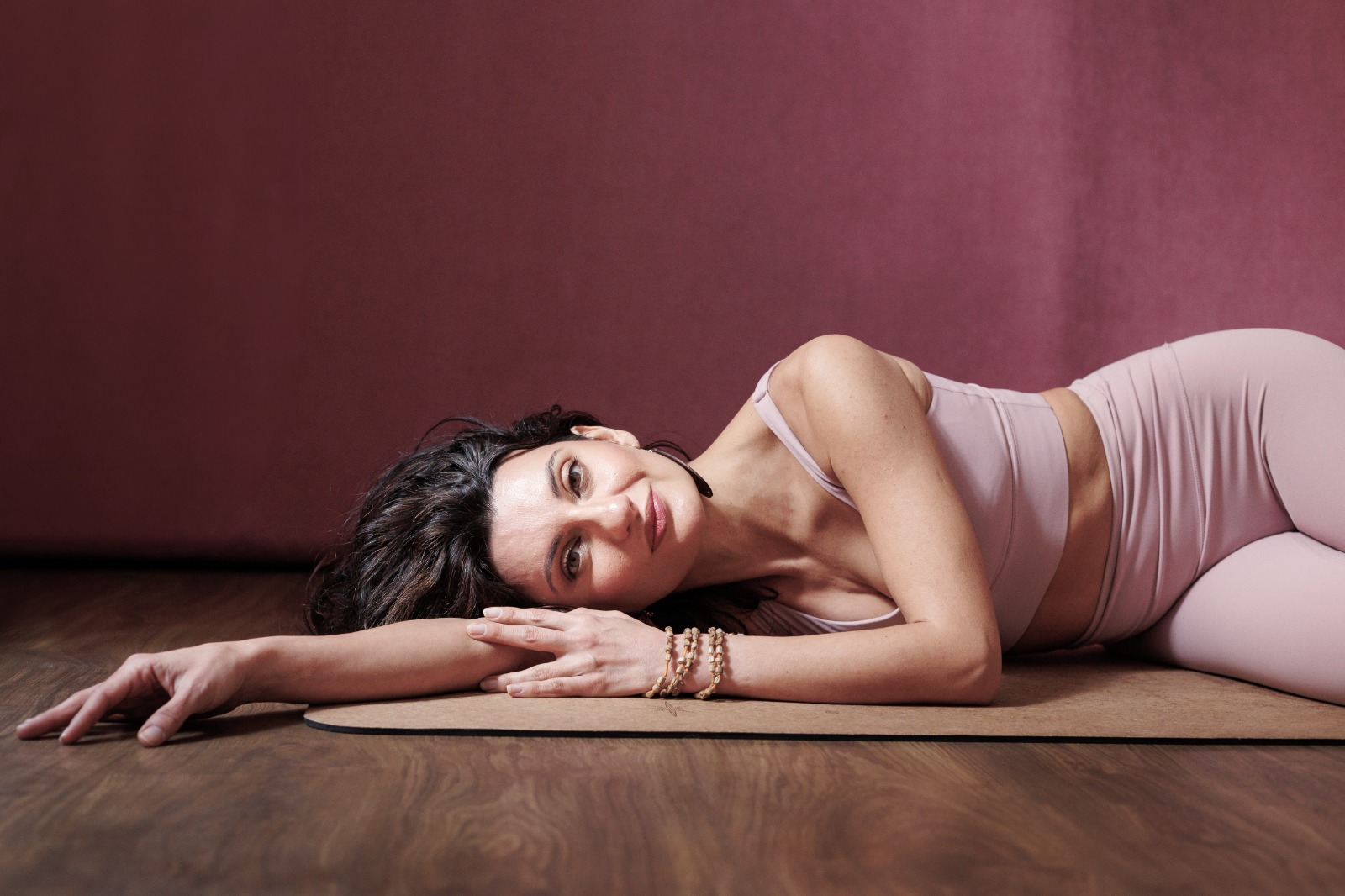
I began practicing yoga about 10 years ago, during a difficult period in my life. I had wanted to start for some time, but I didn’t really know where to begin or whether I had the patience for something that seemed to require time and presence. In Bucharest, there weren’t many studios back then—or perhaps I simply didn’t know about them.
I was already in a process of personal analysis, going to therapy, and I intuitively felt that I wasn’t very connected to my body. Less intuitively, I had back pain, with a clear diagnosis and specific exercise recommendations. On the outside, I seemed fine: I was fit, a young mother, full of energy. Looking back, I realize that I found it difficult to truly inhabit my body, out of haste and lack of awareness, and that, more than anything, I simply wanted to feel better in it.
I became friends with a yoga practitioner who showed me a few postures, and I began practicing at home, without guidance, at my own pace. I oriented myself by the number of breaths in each posture and by the small pauses of stillness between postures. I liked it a lot, even though I could tell that there were poses I wasn’t doing well and moments when I pushed myself more than necessary. But even so, yoga offered me something I had never experienced before: attention, presence, and the beginning of a dialogue with my body.
I was 34 years old and divorced. Each meeting with myself on the mat, alone, in my room, during that period, meant a return to myself and to the possibility of feeling. Of letting tears flow, of experiencing the pain of a shattered illusion, the uncertainty, the sense of failure, the fear that I no longer knew who I was. I would move, then remain still, and allow emotions to settle in my body. I think that was the first time I thought such things should be taught from primary school: knowing how to move with pain and observe where it manifests in the body. No one had prepared me for this kind of experience through yoga. I knew it was a spiritual practice and I tried to understand the philosophy behind it, but the reality of my physical experiences and the reconnection with my body were far more valuable than theory.
Not only did my back pain disappear, but I also began, timidly, to regain trust in my body and in the possibility of rebuilding my life after divorce. I felt how much yoga helped calm my nervous system and manage waves of negative, self-critical thoughts. I realized that I might not reach enlightenment through yoga, but it certainly helps me return to myself when my mind runs wild and I lose contact with what is good and stable within me.
What benefits yoga brings, beyond flexibility
Over time, I came to understand that the benefits of yoga don’t appear suddenly and aren’t spectacular on the surface. They settle in slowly, almost discreetly, but they profoundly change the way you relate to your body, your mind, and your everyday life.
1. Yoga helps calm the nervous system
One of the most important benefits I experienced was the gradual calming of my nervous system. Through conscious breathing and slow movement, the body learns to exit a state of constant alert. For me, this meant confronting one of the major themes of my life: haste. That constant reflex to do things quickly, to move on, to not stay with what is uncomfortable. Yoga forced me to slow down and to stay a little—then a little longer.
2. It creates a better relationship with the body
Over the years of teaching, I’ve noticed that for many people the relationship with their body is a difficult one: we are dissatisfied with it, criticize it, or ignore it. Yoga changes this dynamic.
Over time, you begin to recognize the body’s signals, respect its limits, and trust it more. Not because it becomes “perfect,” but because you come to see it as a friend, not an obstacle.
3. It improves the ability to manage emotions
Yoga doesn’t eliminate difficult emotions, but it creates a space in which they can be experienced without overwhelming you.
Through the alternation of movement and stillness, the body learns to process emotions instead of blocking them. Over time, this translates into greater emotional stability and less self-criticism.
4. It helps reduce physical pain and tension
In my case, back pain gradually disappeared. Not because I “fixed” my body, but because I began to listen to it.
Yoga works with deep muscles, mobility, and breathing, supporting a more functional and relaxed body.
5. It offers a space to return to yourself
Perhaps the most valuable benefit of yoga is that it offers a constant space to return to yourself. Regardless of what happens externally, the practice becomes a point of stability. A place where you can stop, breathe, and remember who you are—beyond roles, expectations, and noise.
I believe I can say, without fear of being wrong, that yoga is not about performance, but about relationship—with your own body and emotions.
It took some time for me to understand what a gentle practice meant for me. For a while, I believed that more and more intense automatically meant better. And sometimes it does.
But for my relationship with my body, a slower rhythm and a gentler approach were what brought stability. Because they helped me anchor myself and create, internally, a safe space for the woman who grew up with the belief that she wasn’t allowed to take up too much space or time. That haste is proof of efficiency. That asking for time, pause, and gentleness is, somewhere deep down, almost forbidden or illegal.
Why yoga deserves a place in your life
Yoga doesn’t promise spectacular transformations overnight. Instead, it offers something far more valuable: a constant space where body and mind can return to a more natural rhythm.
Through gentle movement, conscious breathing, and attention to your own needs, yoga supports emotional balance, reduces stress, and helps build a healthier relationship with your body.
Whether you’re just starting out or returning to practice after a difficult period, yoga can become real support in everyday life—not as performance, but as a form of care for yourself.